Tuesday, February 8, 2011

No More Procrastination

Just somehow dig in and make a start, the rest should be easy.


Alternative colour scheme can be found here.

Sunday, February 6, 2011

Tips for Greenpois0n RC5 Jailbreakers

Okay, RC5 is finally out and working to provide untethered JB for 4.2.1 on all devices, what does this mean?

  • Although this had not been officially confirmed, the exploit used here is, more likely than not, the long awaited SHAtter. I am fairly sure because the JB comes with custom boot logo (and it is even animated) so it has to be an iboot/kernel level JB which is not exactly abundant.
  • Chronic Dev Team was going to hold onto SHAtter for as long as they can, however it has been patched in beta versions of iOS 4.3 therefore there is no longer any point to save it anymore. They were almost pushed to use it for 4.1 back in October; however limera1n was released just in time so it did not happen.
  • There is currently no usable exploit for 4.3 and up, however Redsnow's Monte mode should allow JB on all future versions as long as you have the shsh blobs for 4.2.1. (The essence of Monte is to insert a patched earlier kernel version at iBoot level, hence the blobs are needed by iTunes to sign the kernel and allow it to load untethered)
As for the greenpois0n software itself, it is still barely usable at the time of writing. You might remember that it took four RC revisions to get greenpois0n working as it should for 4.1; well RC5 and the latest RC5_2 are still buggy like a roach-infested hobo shed. You think geohot is the irresponsible Maverick? Greenpois0n is so crudely assembled that it did not even bother to include activation bundles, you are pretty screwed if you restored a locked phone to default before trying GP. (Solutions are available, read on)

There are plenty of tutorials out there, however I am going to provide my workflow that is least likely to have many hiccups that you might come across otherwise (mainly the issues with activation and the utterly broken Cydia loader in both versions) This also allows for offline operation in case you don't have access to data service or wifi.

  1. Turn on your iPhone, connect it to your computer, back up everything in iTunes just in case. (nothing sould be lost unless you screwed up massively)
  2. Close iTunes, shut down iPhone by holding the Sleep button and slide the red slider as it appears. 
  3. Run redsn0w 0.96rc8, choose the factory 4.21 firmware for your device, follow the instructions and choose "Install Cydia" when prompted. For 3Gs unlockers only: You can choose "install iPad baseband" at the same time to streamline the process.
  4. Run redsn0w again as in step 3 however choose "boot tethered". 
  5. You should enter a fully jailbroken state, run Cydia to initialize it, check other system applications like Safari and make sure everything is working before turning the phone off again. Don't bother downloading any packages yet, we can leave this for later. 
  6. Run greenpois0n RC5, follow the instructions. Note that there is a 5 second countdown at the start for "getting ready", this can be somewhat confusing if you become used to redsn0w's DFU routines. 
  7. Keep the Home button pressed the whole time even after it says "complete", your iPhone should boot up in verbose mode in a minute, simply watch and you should be able to see the boot animation pretty soon.
  8. The phone will turn off automatically when everything is done; simply turn on the phone again to enjoy the benefits of untethered JB.
  • Whenever errors come up or the phone gets stuck at any step for more than 5min in verbose mode, simply force power off by holding Sleep+Home for a few seconds and start over. It actually happens more often than thought so don't panic, just keep trying and it will work eventually. In the worst case you can always use trusty redsn0w to boot tethered and start over from step 6.
  • Unlike limera1n, RC5 does not contain any activation bundles. If you are having trouble getting past the activation screen, you will have to run redsn0w 0.97beta6 to hacktivate. The usual precautions of hactivating still apply and it is always better to activate using the right carrier's SIM.
  • RC5 is Mac-only and will fail within virtual machines or hackintosh. RC5_2 is said to work with VM at least however I still recommend getting hold of a Mac before wasting your own time due to pod2g's own impotency.

Wednesday, February 2, 2011

Positivity and Cold War Relics

The more things change, the more they stay the same. What I really need to remind myself of:


* The beginning is probably the most difficult part. Think how you struggle to get out of bed every morning thinking that you are about to die, only to sober up in a few minutes like it never happened.
* Stop worrying that you are not doing good enough. The one who laughs last is not the best player but the one who made the least mistakes. It is always too early to give up.


--------------------------------------------------------------------------------

I was driving home yesterday when I saw an old acquaintance.


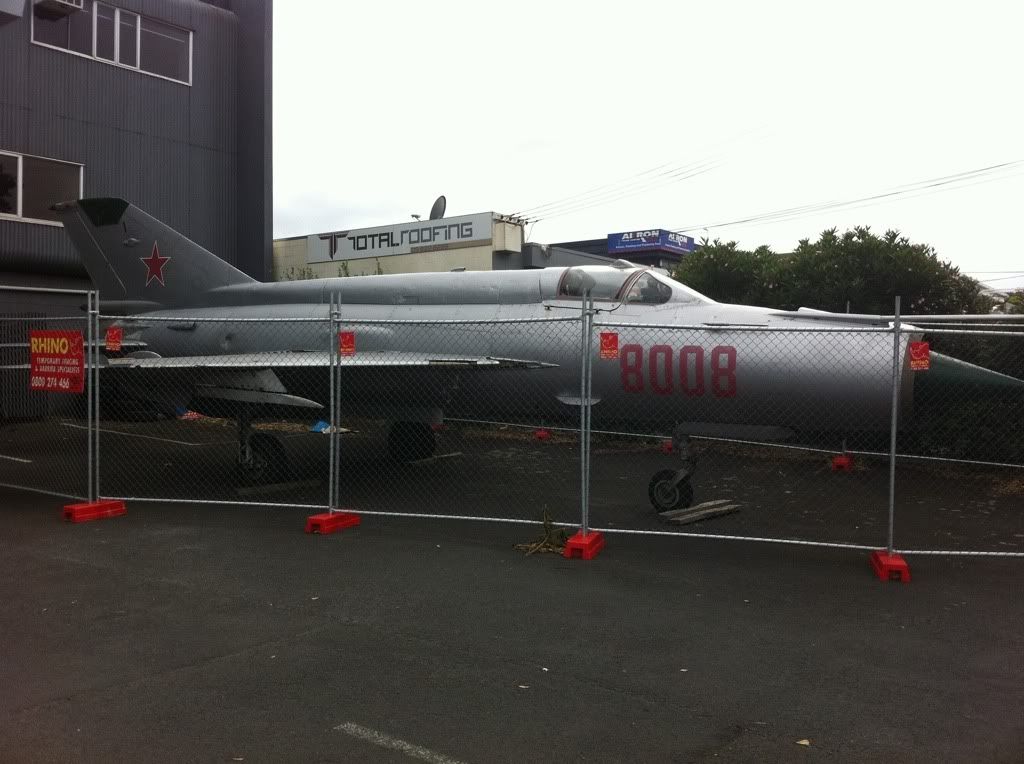
The 1973 MiG-21 was imported in the 1980s through a third country to Australia with the intention of selling it to the RAAF for combat simulation, however the Cold War ended too soon for the jet to me put into real use. The sale fell through, and the aircraft somehow ended up in God's own country following some ambiguous circumstances.

The last time I found it in a derelict hanger in Christchurch airport, I did not have the chance to take a photo however I remember it was already in a dire condition however intact. It also did not have the BOOB 8008 marking. I wonder if the number actually meant anything.

It was put on auction last year without the flaps and some other small bits. Right now it is sitting in a makeshift pen in Penrose and missing her wingtips. I have no idea who bought it to Auckland and why, however I really suspect that it will eventually be scrapped and turned into cans and windows frames.

The laws of nature never gets old.

Wednesday, January 26, 2011

Mobile Network 101 Finale

Back to the question I asked at the beginning, why are the pre-4th generation iPhones no better off than a cheap Nokia in New Zealand?


The answer is simple: When the iPhone was first sold in NZ, Vodafone was the only carrier with a GSM service so Apple had no alternatives. However, iPhone was designed for AT&T's 850MHz 3G frequency instead of the European 900MHz that Vodafone uses. While the older iPhone models are able to get 3G service in urban areas where 2100MHz masts are the mainstream, they are out of luck in less populated places as their phones will only get 2G/GSM signal. Ironically XT had the right frequency nationwide, however Telecom opted to offer iPhones through its subsidiary Gen-i only. 


The same issue is not limited to one brand. Motorola A855 or Sholes came in several versions that are nearly identical except for the radio module. The GSM/WCDMA version is called the MILESTONE, which is further divided into European (900/2100), Commonwealth (850/900/2100) and North American (850/1900) flavours, causing much confusion when users move across national boundaries; and the DROID line is CDMA2000 only and without a card slot, making them effectively unusable outside the US, unless you have a friend of a friend to unofficially register your phone with a non-US carrier.

Sometimes it is harder to determine if a certain phone is XT-compatible since 850 and 900 versions may be offered under the same model/part number. A friend working with parallel imported handsets often had to literally sail out, with his newly arrived stock, to a spot in Hauraki Gulf that he knew has only 850MHz coverage.It may sound ridiculous but there are no other ways to tell.

Apple has certainly learned something and the iPhone 4 is given a pent-band 3G baseband; theoretically it should work in any place with some form of WCDMA service.(The FCC documents included a 800MHz band however Apple choose not advertise on this, probably because there are not many 800MHz networks out there) iPhone for CDMA2000 is also due to be released shortly. Motorola has also recently introduced a range of Global phones with both GSM, WCDMA and CDMA2000 hardware, however these phones are programmed with a new type of SIM lock not to work with GSM carriers in the USA while they work without restrictions elsewhere.

Nevertheless, Blackberry has been selling truly global phones for many years so it must have never been a major technological hurdle to combine several radios in one device. The true motivation lies in the lucrative practice of carrier subsidy.

My conclusions from the history of mobile telephony

  • Like all other forms of infrastructure such as electricity and railway, mobile networks are costly to deploy and convenience decisions often lead to many headaches later. Example: Telecom took the hard pill in giving up CDMA2000 altogether,however many telcos elsewhere are still spending billions of dollars every year to expand their present CDMA2000 network and upgrading them to EV-DO Ver.B for commercial reasons with the full knowledge that the system is minimally compatible with successor standards and in a way, already obsolete.
  • Homogeneity created through monopoly is bad, too much diversity is worse.
    • Conforming to the general patterns in industrialisation, latecomers often have considerable advantage since they are not already committed to maintain legacy support. There are many examples: Japan, once they got over the general ineptitude for much of the 2G era, successfully developed a global standard and currently has several of the best and most profitable 3G netoworks world-wide.
    • Theoretically superior technology does not always lead to better results. Example: Telecom's XT is definitely faster than Vodafone's older UMTS stations, however XT is still struggling to catch up with its own precedents in terms of coverage and reliability, the two essential criteria of any good mobile service that appears to have been overlooked in the last 10 years. 
    • Lysenko may have been dead for several decades, his spirit still lives on as purely scientific matters are often swayed by political and/or ideological influences. The same farce is ongoing with the entire WiMAX vs. LTE debate.
    • Tanenbaum noted that public interest (and investment) in scientific advancements usually arrive in waves, hence the evolution is more or less stochastic. Example: 3G was almost killed off following the .com bubble, and it is still struggling to return a profit amid the recent recession.
    A lot of poorly developed science remained alive and well through pure luck, while the most ingenious inventions may easily slip into oblivion if it was born around the wrong time.

    By the way, his book Computer Networks is an essential read for those with further interests in this area.

      Mobile Network 101 Part 3

      In the beginning, Mobiles networks acted just like the wired phone system however over the air. Yet because each base station had limited capacity, it is not practical to maintain dialup-esque uninterrupted data sessions over analogue lines as it uses frequencies badly needed by everybody else. 

      Soon it is found that some bands reserved to control messages can be re-used to send small packets of data, namely 160 latin characters of text. By setting up separate facilities called Short Message Service Centre (SMSC) to route packets, the service could be put into use with little overhead to the network.


      The design proved to be simple yet very efficient;similar protocols were developed for most rival standards such as D-AMPS and CDMA. However just as SMS went viral worldwide, US carriers were unwilling or uninterested in co-ordinating SMSCs that allow text messages to be transferred between different networks. Such handicap resulted in a persistent lack of reliable SMS service and consumer interest in north America, leading to third-party services such as BIS that works independently across all networks. Texting between carriers is no longer an issue in US(quirks do remain, such as non-latin messages routinely gets corrupted should they cross network barriers), SMS is often not a regular service for mobile services but a paid add-on.


      For a while, SMS was the only method of data transmission over GSM networks. People even wrote protocols to control remote devices via SMS. Fortunately, it did not take long before someone realised that a packet-based layer would be placed alongside voice in the digitised radio. By the time GPRS standard has stablised, it is capable of 80kbps download and 20bps upload, faster than dial-up on copper wire. However to achieve this speed, five concurrent TDMA timeslots must be used, hogging up a large portion of scarce network capacity. To furthur increase bandwidth, the need for new technology could not be any more obvious.

      Numerous submissions were made, and the winner turned out to be a surprise to everybody. NTT DoCoMo's W-CDMA, a hybrid protocol using a CDMA air interface for capacity, while preserving the GSM core network to minimise transition costs and allow handsets to move seamlessly between 2G to 3G. Bearing in mind that Japan never had any commercial GSM service, we could only assume that NTT designed W-CDMA (soon to be known as UMTS), to be a global standard.


      Legacy support was proven in its value such as in case of Vodafone NZ, which operates both WCDMA and GSM network. The latter is available in case the former fails. Whereas Telecom runs to incompatible standards (XT and CDMA2000), disruptions in XT service turned out to be a major flop.

      CDMA was designed to be data-compatible from ground up. It underwent its own evolution into CDMA2000, and became fully 3G with the EV-DO extension, which happened before any other standards were formed. While CDMA2000 uses a much smaller channel which means it hogs less frequency, the smaller bandwidth meant that there is little room for expansion, and voice call cannot exist simutaneously with an active data session. 

      3G was, shortly before the millennium, touted as the greatest thing that was ever invented since the lightbulb and sliced bread to "change the way we live forever". National authorities put 3G frequencies for auction and netted billions of dollars. However, the .com bubble promptly went burst thereafter and the hype suddenly died away. For many years, 3G was considered nothing more than combination of gimmicks like video calling; nobody took it seriously. 

      Some of the players like Nortel never recovered from the damage and went out of business in another bad cycle. With the rollout of 4G and 4G-ish networks imminent, most operators have so far failed to recover their cost from the entire 3G fiasco.

      One of the main reason was that few handsets were truly taking the advantage of 3G before 2007. Yes, I am talking about the iPhone. Before that, most phones are optimised for GPRS: messages were text only and browsers only return stripped down WAP pages. We all dislike iPhone for many reasons, but it is truly the game changer as everybody realised that how much rich media they could provide on people's everyday carry.

      The slow transition to 3G is accompanied by the decline of two 2G-era giants: RIM and Nokia. I will write more about them in another post.

      If it was not for the recession, three independent standards would have played out for 4G: LTE for the GSM/UMTS camp, UMB for CDMA2000 and WiMAX as an extended 802.11 protocol. Qualcomm, reacting to not-so-favourable financial conditions, decided to ditch UMB and concentrate on allowing present CDMA2000 networks to migrate to LTE.

      Right now, most 3G carriers are planning for LTE while brading their HSPA+ compatible networks as 4G in all advertising material to attract attention. WiMAX has been deployed in a few places, however it's future as a major standard remains unclear.