Thanks to personal circumstances and endless piles of stuff from work, I have epically missed all the movies I was supposed to see since the start of the break. Well, I am not going to miss this one. The few pre-release reviews I have read has been generally positive. Although I have a few doubts about the cast, the trailers look pretty delish.
Gantz is probably the most realistic manga I have read. Not only is it extremely graphic and blasphemous, but also for the lack of voyeuristic/philosophical nonsense that seems to be the norm today.
Most people suffer more or less from the Pygmalion Syndrome where they fall in love with their creations and it becomes too hard for them to let go. Oku, however, has taken a rare kind of apathy in Gantz. I mean, his characters may not be very likable, but which other author kills 90% of the main cast in two chapters of a single story arc that is not even halfway into the plot?
The anime adaptation shared a lot of similarities with Fullmetal Alchemist, with the weekly episodes progressing too fast on the storyline, eventually getting to a point that it runs out of material from the still ongoing manga. Both productions decided to supply original story to finish off the season. This is where the Gantz failed as the new segments were badly written and stripped of the realistic aura. Although FMA's divergence from the original was much better executed and received, a new anime had been made later to recreate the story as intended by the author.I seriously look forward to another Gantz anime; in the meantime the movie will help to fix my cravings.
Tuesday, January 25, 2011
Sunday, January 23, 2011
Tomorrow I will hold a bottle against the sun
if the weather is good and the following is true:
"Tonic water will fluoresce under ultraviolet light, owing to the presence of quinine. In fact, the sensitivity of quinine to ultraviolet light (UV) is such that it will visibly fluoresce in direct sunlight."
"Tonic water will fluoresce under ultraviolet light, owing to the presence of quinine. In fact, the sensitivity of quinine to ultraviolet light (UV) is such that it will visibly fluoresce in direct sunlight."

Thursday, January 20, 2011
My $0.02 on the CIE vs. NCEA debate
I was in Year 10 when the government pulled the plug on Bursary and my school seniors back then were the first hatch of guinea pigs fed to the burgeoning monster called NCEA. The principal of the school I went to at the time was one of the chief architect of NCEA. The other high school in the area up the road reacted by offering Cambridge International Examinations, to which the chief architect (who unsurprisingly works for NZQA now) made some rather personal and unpleasant attacks in front of the entire school during an assembly. Although NCEA formally starts at Year 11, we were given plenty of mock assessments in order to prepare for the real deal.
With a twist of fate, I ended up in the other school and took up CIE for the next three years. Hence I feel qualified to speak for the pros and cons of both.
One persistent criticism of NCEA from parents is that it is "too easy" compared to other "tried and true" systems. This is more of a misconception. Well, every system has loopholes that can be exploited to make academic load as light as possible without compromising an UE. The curriculum is actually similar and CIE is hardly more advanced than NCEA in terms of content.
Like this editorial have judged correctly, the consistency issues NCEA had has largely been fixed. Schools resent NCEA because of the sheer amount of internal assessments to manage and process. The issue is more acute in schools offering alternatives to NCEA since two details of staff must be maintained.(Initially teachers taught both, however it was soon found to be unpractical)
A more serious problem is that once the student population start going to separate sets of classes, they effectively split into two cliques, with the NCEA kids accepting some baseless inferiority. Some subjects such as art or PE maybe taught in combined classes, where the division turned into open hostility as the two groups blame each other whenever something went wrong. The bipolar-ness even seems to take precedence over the usual socio-economic or lingo-ethnic lines.
On the other hand, the real risk of taking CIE is the development of bad studying habits. Since everything that matters is this one big exam at the end of the year, it is not too hard to slack off for most of the time. Once at university, many papers have a significant proportion of marks allocated to in-course assessments, which took me almost two years to actually adjust to.
Putting things in context, the early- and mid-noughties were such a good time when the economies were soaring, the All Blacks seemed invincible and Sister Helen ruled the nation with a firm hand. Republicanism was also flying high. The shift to NCEA happened concurrently with the vote in Parliament to abolish rights to appeal to the Privy council, not a coincidence. Therefore, it is not difficult to understand why Auckland Grammar, the most reactionary of public schools out there, to ditch the blighted national standard, with many whitebread high schools rallying under the same banner.
Saturday, January 15, 2011
Sometimes I miss Dr Wily
“Don't ever become a pessimist, Ira; a pessimist is correct oftener than an optimist, but an optimist has more fun--and neither can stop the march of events.”
Somebody I know had the line in his MSN signature for years. Despite being a generally curious person, I have been reading this line over and over without ever wanting to know where it came from. I could have found out in a few seconds but I had always been afraid that it could have meant something totally different. Indeed, when I read the book from where this line was quoted from, it is actually a lot less powerful in context.
Anyway, I have stopped worrying about thing once I realise that it will never end.
Monday, January 3, 2011
My (belated) farewell to the noughties
I decided against creating any New Year's resolutions because I know that I will not be able to adhere to them. The goals I set for December was a huge disappointment: Running exercise seem to have hit a wall at 3km per day, I am still making the few staple dishes, this blog was hardly updated at all and I have made no effort towards touch typing at all.
What was the positive spirit back then must have escaped me, and I will blame humidity/government/arsenic/cosmic radiation. Apologies if this does not make any sense, it is not meant to.
The rest, you may ignore kindly.
Do you like crumpets?
Yes, I actually do. Crumpets are like beer or L&P: it tastes horrible at room temperature but like heaven when toasted/chilled.
So what are you doing here?
I am writing my first blog post in the year of 2011. The majority of readers reached this blog through search engines looking for specific information, you know, the objective stuff. I am aware that my life is not exactly Shortland Street material and this is exactly another post about someone else's life that few would be interested in.
Do you remember the first time you changed your tyre?
One's life is not complete without a tyre change, but that is not my point. The first time I changed a tyre I did so without help, which is not too hard anyway. You park the car on a flat piece of land, jack it up to free the wheels, remove the cover, unscrew the bolts and the rest should be self-explanatory. It would not have been such fond memory if it happened with someone's aid.
Asking for help is more humiliating than begging for money. I can read and search all night for the solution, however the acts to call for help is to admit that you have failed to figure out yourself. Classroom learning is an issue, for teachers are hired to teach and a student's occupation is to learn; similarly I have no problems whatsoever calling a plumber because he get paid to get his hand dirty in my place.
For some reason people often come to me with their questions, and on numerous occasions these questions were so basic that I am annoyed and astonished at the same time, not only because the answer can be found on the first page of a relevant google search, but also they don't see anything wrong with a (by my standard) stupid question. I would have been able to get more done with the same amount of "shamelessness", right?
A “critic” is a man who creates nothing and thereby feels qualified to judge the work of creative men. There is logic in this; he is unbiased—he hates all creative people equally.
This is not quite the case: I don't hate creators; I am jealous. Not because they are better at what they are doing (some of them are, the others are not), but all for their seemingly inexplainable confidence in what they are doing.
Or probably we are all the same, just hiding it so well that we cannot tell from each other's faces.
If someone had told me that at the time, I would have laughed at him. Being unpopular in school makes kids miserable, some of them so miserable that they commit suicide. Telling me that I didn't want to be popular would have seemed like telling someone dying of thirst in a desert that he didn't want a glass of water. Of course I wanted to be popular.
But in fact I didn't, not enough. There was something else I wanted more: to be smart. Not simply to do well in school, though that counted for something, but to design beautiful rockets, or to write well, or to understand how to program computers. In general, to make great things.
At the time I never tried to separate my wants and weigh them against one another. If I had, I would have seen that being smart was more important. If someone had offered me the chance to be the most popular kid in school, but only at the price of being of average intelligence (humor me here), I wouldn't have taken it.
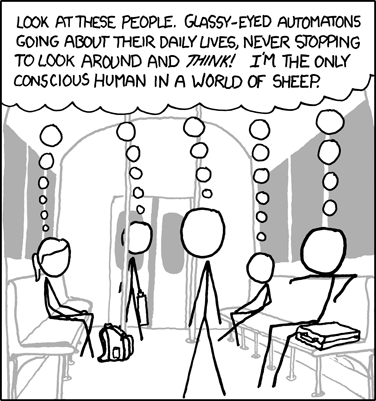
The predicament for me and the likes of myself is that we assume everybody else think and behave just like us: sensitive, considerate and calculated, yet they are not.
We all know that the world does not cease to exist when we close our eyes, however I suspect there had been plenty of thoughts and prayers, from people who lost all their will to live, that the sun shall not rise tomorrow if they die today.
I am not suicidal or trying to be vague-smug. Sometimes there are so many voices in your head to be let out. I must write these down, hence I write.
Do you like crumpets?
Not that it's any different from pikelets.
What was the positive spirit back then must have escaped me, and I will blame humidity/government/arsenic/cosmic radiation. Apologies if this does not make any sense, it is not meant to.
The rest, you may ignore kindly.
------------------------------------------------------------------------------------------------------------
Do you like crumpets?
Yes, I actually do. Crumpets are like beer or L&P: it tastes horrible at room temperature but like heaven when toasted/chilled.
So what are you doing here?
I am writing my first blog post in the year of 2011. The majority of readers reached this blog through search engines looking for specific information, you know, the objective stuff. I am aware that my life is not exactly Shortland Street material and this is exactly another post about someone else's life that few would be interested in.
To sound like a grumpy old man is probably the last thing I wanted to do, however I am already losing grip on things that happened in the last decade. What I have crammed so hard for my last exams has already been completely forgotten and today I opened a book only to realise half an hour later that I have read the very same title four years ago. Psychology, I have long since learned and accepted memory as mutable and unreliable, however the experience still upsets me greatly.
“You see,” he explained, “I consider that a man’s brain originally is like a little empty attic, and you have to stock it with such furniture as you choose. A fool takes in all the lumber of every sort that he comes across, so that the knowledge which might be useful to him gets crowded out, or at best is jumbled up with a lot of other things, so that he has a difficulty in laying his hands upon it. Now the skilful workman is very careful indeed as to what he takes into his brain-attic. He will have nothing but the tools which may help him in doing his work, but of these he has a large assortment, and all in the most perfect order. It is a mistake to think that that little room has elastic walls and can distend to any extent. Depend upon it there comes a time when for every addition of knowledge you forget something that you knew before. It is of the highest importance, therefore, not to have useless facts elbowing out the useful ones.”
 “But the Solar System!” I protested.
“What the deuce is it to me?” he interrupted impatiently: “you say that we go round the sun. If we went round the moon it would not make a pennyworth of difference to me or to my work.”
“But the Solar System!” I protested.“What the deuce is it to me?” he interrupted impatiently: “you say that we go round the sun. If we went round the moon it would not make a pennyworth of difference to me or to my work.”You can read all about everything and still not get, in fact you will never get it until the moment you live it. The people who wrote those books are not necessarily making things up like Neil Gaiman prefers to boast, instead they are relying on their own life-experiences and a certain degree of psychosis.
"What sets the ordinary apart from the extraordinary is the nirvana of literature, the state in which the characters acquired the ghosts of their own. For the authors had no control nor prediction to what will happen the next page, they had stalked their own brainchild with restless curiosity to every minor detail of their life. From Shakespeare to Balzac to Tolstoy, the sacred womb of creativity is no different to the obsession of the lowest voyeur."
"What sets the ordinary apart from the extraordinary is the nirvana of literature, the state in which the characters acquired the ghosts of their own. For the authors had no control nor prediction to what will happen the next page, they had stalked their own brainchild with restless curiosity to every minor detail of their life. From Shakespeare to Balzac to Tolstoy, the sacred womb of creativity is no different to the obsession of the lowest voyeur."
-------------------------------------------------------------------------------------------------------------
Do you remember the first time you changed your tyre?
One's life is not complete without a tyre change, but that is not my point. The first time I changed a tyre I did so without help, which is not too hard anyway. You park the car on a flat piece of land, jack it up to free the wheels, remove the cover, unscrew the bolts and the rest should be self-explanatory. It would not have been such fond memory if it happened with someone's aid.
Asking for help is more humiliating than begging for money. I can read and search all night for the solution, however the acts to call for help is to admit that you have failed to figure out yourself. Classroom learning is an issue, for teachers are hired to teach and a student's occupation is to learn; similarly I have no problems whatsoever calling a plumber because he get paid to get his hand dirty in my place.
For some reason people often come to me with their questions, and on numerous occasions these questions were so basic that I am annoyed and astonished at the same time, not only because the answer can be found on the first page of a relevant google search, but also they don't see anything wrong with a (by my standard) stupid question. I would have been able to get more done with the same amount of "shamelessness", right?
A “critic” is a man who creates nothing and thereby feels qualified to judge the work of creative men. There is logic in this; he is unbiased—he hates all creative people equally.
This is not quite the case: I don't hate creators; I am jealous. Not because they are better at what they are doing (some of them are, the others are not), but all for their seemingly inexplainable confidence in what they are doing.
Or probably we are all the same, just hiding it so well that we cannot tell from each other's faces.
-------------------------------------------------------------------------------------------------------------
If someone had told me that at the time, I would have laughed at him. Being unpopular in school makes kids miserable, some of them so miserable that they commit suicide. Telling me that I didn't want to be popular would have seemed like telling someone dying of thirst in a desert that he didn't want a glass of water. Of course I wanted to be popular.
But in fact I didn't, not enough. There was something else I wanted more: to be smart. Not simply to do well in school, though that counted for something, but to design beautiful rockets, or to write well, or to understand how to program computers. In general, to make great things.
At the time I never tried to separate my wants and weigh them against one another. If I had, I would have seen that being smart was more important. If someone had offered me the chance to be the most popular kid in school, but only at the price of being of average intelligence (humor me here), I wouldn't have taken it.
The predicament for me and the likes of myself is that we assume everybody else think and behave just like us: sensitive, considerate and calculated, yet they are not.
We all know that the world does not cease to exist when we close our eyes, however I suspect there had been plenty of thoughts and prayers, from people who lost all their will to live, that the sun shall not rise tomorrow if they die today.
I am not suicidal or trying to be vague-smug. Sometimes there are so many voices in your head to be let out. I must write these down, hence I write.
Do you like crumpets?
Not that it's any different from pikelets.
Subscribe to:
Posts (Atom)