I was in Year 10 when the government pulled the plug on Bursary and my school seniors back then were the first hatch of guinea pigs fed to the burgeoning monster called NCEA. The principal of the school I went to at the time was one of the chief architect of NCEA. The other high school in the area up the road reacted by offering Cambridge International Examinations, to which the chief architect (who unsurprisingly works for NZQA now) made some rather personal and unpleasant attacks in front of the entire school during an assembly. Although NCEA formally starts at Year 11, we were given plenty of mock assessments in order to prepare for the real deal.
With a twist of fate, I ended up in the other school and took up CIE for the next three years. Hence I feel qualified to speak for the pros and cons of both.
One persistent criticism of NCEA from parents is that it is "too easy" compared to other "tried and true" systems. This is more of a misconception. Well, every system has loopholes that can be exploited to make academic load as light as possible without compromising an UE. The curriculum is actually similar and CIE is hardly more advanced than NCEA in terms of content.
Like this editorial have judged correctly, the consistency issues NCEA had has largely been fixed. Schools resent NCEA because of the sheer amount of internal assessments to manage and process. The issue is more acute in schools offering alternatives to NCEA since two details of staff must be maintained.(Initially teachers taught both, however it was soon found to be unpractical)
A more serious problem is that once the student population start going to separate sets of classes, they effectively split into two cliques, with the NCEA kids accepting some baseless inferiority. Some subjects such as art or PE maybe taught in combined classes, where the division turned into open hostility as the two groups blame each other whenever something went wrong. The bipolar-ness even seems to take precedence over the usual socio-economic or lingo-ethnic lines.
On the other hand, the real risk of taking CIE is the development of bad studying habits. Since everything that matters is this one big exam at the end of the year, it is not too hard to slack off for most of the time. Once at university, many papers have a significant proportion of marks allocated to in-course assessments, which took me almost two years to actually adjust to.
Putting things in context, the early- and mid-noughties were such a good time when the economies were soaring, the All Blacks seemed invincible and Sister Helen ruled the nation with a firm hand. Republicanism was also flying high. The shift to NCEA happened concurrently with the vote in Parliament to abolish rights to appeal to the Privy council, not a coincidence. Therefore, it is not difficult to understand why Auckland Grammar, the most reactionary of public schools out there, to ditch the blighted national standard, with many whitebread high schools rallying under the same banner.
Thursday, January 20, 2011
Saturday, January 15, 2011
Sometimes I miss Dr Wily
“Don't ever become a pessimist, Ira; a pessimist is correct oftener than an optimist, but an optimist has more fun--and neither can stop the march of events.”
Somebody I know had the line in his MSN signature for years. Despite being a generally curious person, I have been reading this line over and over without ever wanting to know where it came from. I could have found out in a few seconds but I had always been afraid that it could have meant something totally different. Indeed, when I read the book from where this line was quoted from, it is actually a lot less powerful in context.
Anyway, I have stopped worrying about thing once I realise that it will never end.
Somebody I know had the line in his MSN signature for years. Despite being a generally curious person, I have been reading this line over and over without ever wanting to know where it came from. I could have found out in a few seconds but I had always been afraid that it could have meant something totally different. Indeed, when I read the book from where this line was quoted from, it is actually a lot less powerful in context.
Anyway, I have stopped worrying about thing once I realise that it will never end.

Monday, January 3, 2011
My (belated) farewell to the noughties
I decided against creating any New Year's resolutions because I know that I will not be able to adhere to them. The goals I set for December was a huge disappointment: Running exercise seem to have hit a wall at 3km per day, I am still making the few staple dishes, this blog was hardly updated at all and I have made no effort towards touch typing at all.
What was the positive spirit back then must have escaped me, and I will blame humidity/government/arsenic/cosmic radiation. Apologies if this does not make any sense, it is not meant to.
The rest, you may ignore kindly.
Do you like crumpets?
Yes, I actually do. Crumpets are like beer or L&P: it tastes horrible at room temperature but like heaven when toasted/chilled.
So what are you doing here?
I am writing my first blog post in the year of 2011. The majority of readers reached this blog through search engines looking for specific information, you know, the objective stuff. I am aware that my life is not exactly Shortland Street material and this is exactly another post about someone else's life that few would be interested in.

Do you remember the first time you changed your tyre?
One's life is not complete without a tyre change, but that is not my point. The first time I changed a tyre I did so without help, which is not too hard anyway. You park the car on a flat piece of land, jack it up to free the wheels, remove the cover, unscrew the bolts and the rest should be self-explanatory. It would not have been such fond memory if it happened with someone's aid.
Asking for help is more humiliating than begging for money. I can read and search all night for the solution, however the acts to call for help is to admit that you have failed to figure out yourself. Classroom learning is an issue, for teachers are hired to teach and a student's occupation is to learn; similarly I have no problems whatsoever calling a plumber because he get paid to get his hand dirty in my place.
For some reason people often come to me with their questions, and on numerous occasions these questions were so basic that I am annoyed and astonished at the same time, not only because the answer can be found on the first page of a relevant google search, but also they don't see anything wrong with a (by my standard) stupid question. I would have been able to get more done with the same amount of "shamelessness", right?
A “critic” is a man who creates nothing and thereby feels qualified to judge the work of creative men. There is logic in this; he is unbiased—he hates all creative people equally.
This is not quite the case: I don't hate creators; I am jealous. Not because they are better at what they are doing (some of them are, the others are not), but all for their seemingly inexplainable confidence in what they are doing.
Or probably we are all the same, just hiding it so well that we cannot tell from each other's faces.

If someone had told me that at the time, I would have laughed at him. Being unpopular in school makes kids miserable, some of them so miserable that they commit suicide. Telling me that I didn't want to be popular would have seemed like telling someone dying of thirst in a desert that he didn't want a glass of water. Of course I wanted to be popular.
But in fact I didn't, not enough. There was something else I wanted more: to be smart. Not simply to do well in school, though that counted for something, but to design beautiful rockets, or to write well, or to understand how to program computers. In general, to make great things.
At the time I never tried to separate my wants and weigh them against one another. If I had, I would have seen that being smart was more important. If someone had offered me the chance to be the most popular kid in school, but only at the price of being of average intelligence (humor me here), I wouldn't have taken it.
The predicament for me and the likes of myself is that we assume everybody else think and behave just like us: sensitive, considerate and calculated, yet they are not.
We all know that the world does not cease to exist when we close our eyes, however I suspect there had been plenty of thoughts and prayers, from people who lost all their will to live, that the sun shall not rise tomorrow if they die today.
I am not suicidal or trying to be vague-smug. Sometimes there are so many voices in your head to be let out. I must write these down, hence I write.
Do you like crumpets?
Not that it's any different from pikelets.
What was the positive spirit back then must have escaped me, and I will blame humidity/government/arsenic/cosmic radiation. Apologies if this does not make any sense, it is not meant to.
The rest, you may ignore kindly.
------------------------------------------------------------------------------------------------------------
Do you like crumpets?
Yes, I actually do. Crumpets are like beer or L&P: it tastes horrible at room temperature but like heaven when toasted/chilled.
So what are you doing here?
I am writing my first blog post in the year of 2011. The majority of readers reached this blog through search engines looking for specific information, you know, the objective stuff. I am aware that my life is not exactly Shortland Street material and this is exactly another post about someone else's life that few would be interested in.
To sound like a grumpy old man is probably the last thing I wanted to do, however I am already losing grip on things that happened in the last decade. What I have crammed so hard for my last exams has already been completely forgotten and today I opened a book only to realise half an hour later that I have read the very same title four years ago. Psychology, I have long since learned and accepted memory as mutable and unreliable, however the experience still upsets me greatly.
“You see,” he explained, “I consider that a man’s brain originally is like a little empty attic, and you have to stock it with such furniture as you choose. A fool takes in all the lumber of every sort that he comes across, so that the knowledge which might be useful to him gets crowded out, or at best is jumbled up with a lot of other things, so that he has a difficulty in laying his hands upon it. Now the skilful workman is very careful indeed as to what he takes into his brain-attic. He will have nothing but the tools which may help him in doing his work, but of these he has a large assortment, and all in the most perfect order. It is a mistake to think that that little room has elastic walls and can distend to any extent. Depend upon it there comes a time when for every addition of knowledge you forget something that you knew before. It is of the highest importance, therefore, not to have useless facts elbowing out the useful ones.”
 “But the Solar System!” I protested.
“What the deuce is it to me?” he interrupted impatiently: “you say that we go round the sun. If we went round the moon it would not make a pennyworth of difference to me or to my work.”
“But the Solar System!” I protested.“What the deuce is it to me?” he interrupted impatiently: “you say that we go round the sun. If we went round the moon it would not make a pennyworth of difference to me or to my work.”You can read all about everything and still not get, in fact you will never get it until the moment you live it. The people who wrote those books are not necessarily making things up like Neil Gaiman prefers to boast, instead they are relying on their own life-experiences and a certain degree of psychosis.
"What sets the ordinary apart from the extraordinary is the nirvana of literature, the state in which the characters acquired the ghosts of their own. For the authors had no control nor prediction to what will happen the next page, they had stalked their own brainchild with restless curiosity to every minor detail of their life. From Shakespeare to Balzac to Tolstoy, the sacred womb of creativity is no different to the obsession of the lowest voyeur."
"What sets the ordinary apart from the extraordinary is the nirvana of literature, the state in which the characters acquired the ghosts of their own. For the authors had no control nor prediction to what will happen the next page, they had stalked their own brainchild with restless curiosity to every minor detail of their life. From Shakespeare to Balzac to Tolstoy, the sacred womb of creativity is no different to the obsession of the lowest voyeur."
-------------------------------------------------------------------------------------------------------------
Do you remember the first time you changed your tyre?
One's life is not complete without a tyre change, but that is not my point. The first time I changed a tyre I did so without help, which is not too hard anyway. You park the car on a flat piece of land, jack it up to free the wheels, remove the cover, unscrew the bolts and the rest should be self-explanatory. It would not have been such fond memory if it happened with someone's aid.
Asking for help is more humiliating than begging for money. I can read and search all night for the solution, however the acts to call for help is to admit that you have failed to figure out yourself. Classroom learning is an issue, for teachers are hired to teach and a student's occupation is to learn; similarly I have no problems whatsoever calling a plumber because he get paid to get his hand dirty in my place.
For some reason people often come to me with their questions, and on numerous occasions these questions were so basic that I am annoyed and astonished at the same time, not only because the answer can be found on the first page of a relevant google search, but also they don't see anything wrong with a (by my standard) stupid question. I would have been able to get more done with the same amount of "shamelessness", right?
A “critic” is a man who creates nothing and thereby feels qualified to judge the work of creative men. There is logic in this; he is unbiased—he hates all creative people equally.
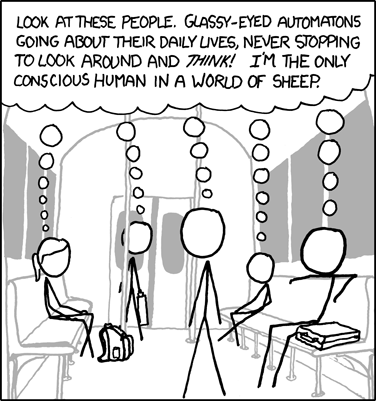
This is not quite the case: I don't hate creators; I am jealous. Not because they are better at what they are doing (some of them are, the others are not), but all for their seemingly inexplainable confidence in what they are doing.
Or probably we are all the same, just hiding it so well that we cannot tell from each other's faces.
-------------------------------------------------------------------------------------------------------------
If someone had told me that at the time, I would have laughed at him. Being unpopular in school makes kids miserable, some of them so miserable that they commit suicide. Telling me that I didn't want to be popular would have seemed like telling someone dying of thirst in a desert that he didn't want a glass of water. Of course I wanted to be popular.
But in fact I didn't, not enough. There was something else I wanted more: to be smart. Not simply to do well in school, though that counted for something, but to design beautiful rockets, or to write well, or to understand how to program computers. In general, to make great things.
At the time I never tried to separate my wants and weigh them against one another. If I had, I would have seen that being smart was more important. If someone had offered me the chance to be the most popular kid in school, but only at the price of being of average intelligence (humor me here), I wouldn't have taken it.
The predicament for me and the likes of myself is that we assume everybody else think and behave just like us: sensitive, considerate and calculated, yet they are not.
We all know that the world does not cease to exist when we close our eyes, however I suspect there had been plenty of thoughts and prayers, from people who lost all their will to live, that the sun shall not rise tomorrow if they die today.
I am not suicidal or trying to be vague-smug. Sometimes there are so many voices in your head to be let out. I must write these down, hence I write.
Do you like crumpets?
Not that it's any different from pikelets.
Thursday, December 16, 2010
V1, V2
Hello again my crippled blog. Life has recently become very hectic with day jobs taking a larger cut of my time than expected and few other things keep holding me up. Exactly two week ago I pledged to update this blog more often, well...
Partly because Part 3 of my mobile network series is taking much longer as I have underestimated the amount of research. Besides, I have been distracted with the temporary ownership of an iPhone 4 for which I took the advantage of carrier subsidy to buy as a Christmas gift for my dear father.
I have had ample opportunity to fiddle with other people's iPhones before which were not all that impressive: The plastic chassis feel cheap, the screen is mediocre and iTunes is a pain to use. The iPad failed to please me the same way with its general lack in productivity features, which even MacFags do admit.
You see, the smoothness of iOS is often achieved through deception. Deliberately disabling multitasking is one thing, for Apple is a clever social engineer to make things appear better than they really are. For example, Safari on the iPhone only render the visible portion of the active tab plus a very small adjacent area to reduce the processing overhead. If you scroll too fast you will be greeted with blank areas cleverly disguised as transparency layers before the system catches up. The interface also tricks people into suspending processes rather than properly killing them, resulting in a seemingly fast launch time when the same process is called again.
However the iPhone 4 is actually quite agreeable. The slim construction of double glass panels and external antennas, despite its susceptibilities to breakage and attenuation, is quite pleasing to sight and feels substantial in your hands. The much-hyped retina screen is also pretty nice, even for someone already accustomed to a high quality screen on the Milestone. Apple have chosen the right resolution that existing apps that were smart enough to uemploy vector graphics can be scaled up without any intervention.

Contrary to conventional wisdom, the history of Apple shows clear continuity from Day 1 while Microsoft's products were often refreshed to the point that it no longer resemble their ancestors. The latest Macs still have some of the quirks of Apple II where critical system timings were taken directly from the bus clock, so binaries not complied with such systems will fail to execute.
The present iOS vs. Android race is an exact duplication of the old PC vs. Mac rivalry. Apple, by controlling the range of hardware, can effectively control the user experience, while their more open opponents must deal with all sorts of segmentation and compatibility issue.

To better explain this, let's look at a recent example. Everybody loves Angry Birds however the initial Android release was unplayable for most people. Simply because with iPhone there are only two hardware branches and one or two OS to maintain, while Android comes in at least three versions, a variety of screen resolutions and a continuum of processing power, which is something that developers, having been spoiled by the iPhone, cannot no longer cope with.
BTW, this game, along with many others, are free for Android but paid in the App Store...Hint hint.
The same issue plagues most apps ported from iOS, where it works poorly with handsets of limited hardware.
This, however, still leaves one question to be answered: Does Apple make people stupid, or are stupid people attracted to Apple?
The answer is, it does not matter, for there is a demon darker than coal trapped in every iDevice. BlendTec has proof.

Partly because Part 3 of my mobile network series is taking much longer as I have underestimated the amount of research. Besides, I have been distracted with the temporary ownership of an iPhone 4 for which I took the advantage of carrier subsidy to buy as a Christmas gift for my dear father.
I have had ample opportunity to fiddle with other people's iPhones before which were not all that impressive: The plastic chassis feel cheap, the screen is mediocre and iTunes is a pain to use. The iPad failed to please me the same way with its general lack in productivity features, which even MacFags do admit.
You see, the smoothness of iOS is often achieved through deception. Deliberately disabling multitasking is one thing, for Apple is a clever social engineer to make things appear better than they really are. For example, Safari on the iPhone only render the visible portion of the active tab plus a very small adjacent area to reduce the processing overhead. If you scroll too fast you will be greeted with blank areas cleverly disguised as transparency layers before the system catches up. The interface also tricks people into suspending processes rather than properly killing them, resulting in a seemingly fast launch time when the same process is called again.
However the iPhone 4 is actually quite agreeable. The slim construction of double glass panels and external antennas, despite its susceptibilities to breakage and attenuation, is quite pleasing to sight and feels substantial in your hands. The much-hyped retina screen is also pretty nice, even for someone already accustomed to a high quality screen on the Milestone. Apple have chosen the right resolution that existing apps that were smart enough to uemploy vector graphics can be scaled up without any intervention.

Taiko no Tatsujin looked so good that I almost thought it was developed natively for 960x640
The added RAM helps to make multitasking possible without sacrificing responsiveness. And the camera deserves special mention too for being exceptional. in such a small package. While I did not regret giving it away, I am looking for a locked 32GB one for entertainment. Overall, it is a glorified and augmented iPod Touch rather than a communication device, for I cannot bear the lack of physical keyboard, notification light and interchangeable batteries found on every other phone.Contrary to conventional wisdom, the history of Apple shows clear continuity from Day 1 while Microsoft's products were often refreshed to the point that it no longer resemble their ancestors. The latest Macs still have some of the quirks of Apple II where critical system timings were taken directly from the bus clock, so binaries not complied with such systems will fail to execute.
The present iOS vs. Android race is an exact duplication of the old PC vs. Mac rivalry. Apple, by controlling the range of hardware, can effectively control the user experience, while their more open opponents must deal with all sorts of segmentation and compatibility issue.

BTW, this game, along with many others, are free for Android but paid in the App Store...Hint hint.
The same issue plagues most apps ported from iOS, where it works poorly with handsets of limited hardware.
This, however, still leaves one question to be answered: Does Apple make people stupid, or are stupid people attracted to Apple?
The answer is, it does not matter, for there is a demon darker than coal trapped in every iDevice. BlendTec has proof.
-------------------------------------------------------------------------------------------------------------
Blogger Stats has not been working for some time and I have put it down to the ineptitude of Google's admins (blogspot.com has been on the downhill road since the takeover by Google), however a recent visit to the message board revealed that the function simply stopped working with Firefox, or any gecko-based browser altogether. Google Analytics, the background service that powers Blogger Stats, are also reported to have many issues with Firefox, including some reports that it does not register visits via Firefox at all. After many years of mutual support, the rift between Google and Mozilla is finally beginning to show.


The period from 2001 to 2005, following the first Browser War, are the dark days of the web with the lamentable Internet Explorer 6.0 dominating the market with only two minor update in two years. Alternatives were available however since most sites are written to support IE, the average layperson are unlikely to use it.
Fortunately the stagnation did not last forever; Firefox came out with Gecko, a brand new, standardised rendering engine, a smooth interface with tab browsing and much better security features. While its market share was never beyond the 30% mark, the real change brought along my Firefox is the renewed competition of development within the browser market.
I thought that Firefox was the forefront of web standardisation however this seems to be no longer the case, and I have similar personal experiences where a KHTML page I authored refused to be rendered correctly in Firefox; Trident renders it correctly only 50% of time however Webkit i.e. Chrome and Safari rendered it without a hitch. I ended up making static versions of the affected pages with a redirection script, which is easier said than done since every browser pretends to be Mozilla.
As for the software itself, it has become increasingly bloated and crash-prone from 3.6 onwards (hence the author is still staying on 3.5 for the remainder of its support lifetime), nor is the 4.0 beta anywhere near ready. Once the developers start to embrace Chrome en masse, there is little advantage left for Firefox.
Unlike Microsoft which has virtually bottomless resources to promote their browser, Firefox had to enter into an agreement with Google which trades search traffic for financing. While this income has allowed Mozilla to keep up the fight in the darkest of days, it is getting less secure because of the inherent conflict of interest.
Finally compared to Opera which successfully captured the niche market of mobile web browsing, Firefox was too dependent on mainstream x86 platforms; Camino was hit hard when Apple defected to x86 and was never really completed, while Fennec is still stuck in beta at the time of writing.

A losing battle from the beginning
With a sad note, I must say that Firefox is losing on all fronts and shall fade away within five years just like its Netscape fathers, not for its own wrongs but a combination of complacency, lack of focus and sheer bad luck.
Wednesday, December 1, 2010
December and Onwards
Today marks the proper beginning of summer as well as my three-month study break. Exam results was released a few days ago and they are probably the best for the entire three years at uni.
There is no magic about getting a better mark apart from actually paying attention in class and taking time to swot. Befriending lecturers also help, a lot of legitimate help will come with way.
The perpetual B student has moved on. Looking back, I wish I have tried harder, not only for the past semesters where I....utterly failed myself, but also the recent ones. If I have tried harder, I should rocking cut-edge science in the air conditioned labs over the holidays while enjoying many elite privileges such as free coffee and unmetered staff internet. Instead I am earning a meager wage three days a day in a small kiosk that feels like the defendant dock at the high court. Fingers crossed that I will get the project I wanted for my honours year.
On the bright side of mundane affairs, missing out on my summer studentship may actually be a kind of blessing since it should give me time to do the following:
This is for the record, I wish for all kinds of help that I will be able to come back to this post 99 days later and cross everything out with a smile on my face.
P.S. Got the first paycheck since starting the new job, hooah!
There is no magic about getting a better mark apart from actually paying attention in class and taking time to swot. Befriending lecturers also help, a lot of legitimate help will come with way.
The perpetual B student has moved on. Looking back, I wish I have tried harder, not only for the past semesters where I....utterly failed myself, but also the recent ones. If I have tried harder, I should rocking cut-edge science in the air conditioned labs over the holidays while enjoying many elite privileges such as free coffee and unmetered staff internet. Instead I am earning a meager wage three days a day in a small kiosk that feels like the defendant dock at the high court. Fingers crossed that I will get the project I wanted for my honours year.
On the bright side of mundane affairs, missing out on my summer studentship may actually be a kind of blessing since it should give me time to do the following:
- Scale down. Since the plans for London fell apart, I have resumed the old habit to acquire too much property and I still do despite my best effort. Getting rid of things is not easy, especially when it comes to your childhood treasures and books. However, things will need to go, for me all die alone and empty-handed.
- Practice touch-typing. I am sure everyone has noticed (but had been too polite to point out) that I type with two fingers, which probably does not match my current job description and geek status. Definitely need some time to practice.
- Get more exercise. Something I have planned for but ultimately failed to act on during the year. Well right now I no longer have any excuse to slack off, and summer should be a great time for losing weight.
- Inspired by the sheer awesomeness of
Amy AdamsJulia & Julia, I have decided to carry out a similar, however less fancy version of kitchen quest with the quintessential classic: The Edmonds Cookery Book. At the rate of two to three dishes per week I am in good position to finish the entire thing before uni starts again. Other meals will be back up with my standard (lit. Atkins) diet of red meat and raw salad, supplemented by the occasional junk food and things that came out of a cardboard box. - Finally update this blog more often, I have always been in requirement of writing exercise and this blog served me great on this purpose. I am also delighted, as the visitor stats of this blog points out, that my babbling did help other people looking for answers to their various questions. A big thank you to all my readers past and present, more content is always on their way.
This is for the record, I wish for all kinds of help that I will be able to come back to this post 99 days later and cross everything out with a smile on my face.
P.S. Got the first paycheck since starting the new job, hooah!
Subscribe to:
Posts (Atom)